Henan Aifite Intelligent Equipment Co., LTD.


FAQ

What are the requirements for the track foundation of a rail-mounted flatcar?
I. Core Requirements for Track Foundations
The track foundation primarily bears the weight of the flatcar itself, the load of goods, and wheel impact. It prevents ground subsidence, track deformation, cracking, and misalignment, ensuring smooth flatcar operation, preventing derailment, and minimizing wear on the motor wheels. All foundations consist of three main parts: the concrete foundation, the track pad layer, and the embedded fixing structure.

II. Rigid Requirements for Concrete Foundations (Most Critical)
1. Concrete Grade
Light Load (≤10t flatcar): C25 concrete
Medium Load (10t~50t): C30 concrete (Most commonly used in factories)
Heavy Load (50t+~200t heavy-duty flatcar): C35 and above
Manufacturers default to designing all concrete to C30; for heavy loads, a higher grade must be used.
2. Foundation Thickness
General values for on-site construction:
Under 10t: Thickness ≥150mm
10~30t: Thickness ≥200mm
30~80t: Thickness ≥250mm
Over 80t (Extra Heavy): 300mm and above, steel mesh recommended.
3. Reinforcement Configuration
Standard flatcars: Two-way steel mesh laid at the bottom.
Reinforcement diameter Φ8~Φ10, mesh spacing 200×200mm.
Heavy loads, soft soil, renovation of old workshop floors: Increase reinforcement density; construct ground beams if necessary.
4. Soil and Backfill Requirements
The original soil beneath the foundation must be compacted, with a compaction coefficient ≥0.95.
Soft soil, backfill, silt: Must be replaced with a crushed stone layer (100~200mm thick) before pouring concrete.
Pour foundations directly onto soft soil or construction waste.
Renovation of existing workshop floors: The bearing capacity needs to be tested; if insufficient, it must be thickened and reinforced.
5. Curing Time
After the concrete is poured, allow it to cure naturally for ≥28 days. Rails can only be laid and flatcars installed after the concrete has reached the required strength. Forcing rail laying before it is fully dry will cause later settlement and cracking.
III. Rail Laying Foundation (Bedding, Fixing, Embedding) Requirements
1. Rail Bedding
The rails cannot be placed directly on the concrete surface; a bedding layer must be added:
Standard: 10mm rubber shock-absorbing pads
Heavy-load, high-frequency operation: Thickened shock-absorbing pads + steel plate bedding
Function: Buffer wheel pressure impact, reduce vibration, reduce noise, protect concrete, and reduce rail loosening.
2. Rail Fixing Methods (Two types, foundation matching requirements)
(1) Embedded type (preferred for factories, stable, long service life, essential for heavy loads)
Embedded channel steel / embedded steel plate during concrete pouring
The rails are fixed to the embedded parts using pressure plates, bolts, and spring washers.
Requirements: Precise embedding position, symmetrical embedded parts for the left and right rails. (2) Post-installed anchors (commonly used in renovated workshops and old floors)
Drill holes after the concrete has hardened and insert chemical anchors to fix the track pressure plate. Requirements:
The anchors must be buried deep enough and have sufficient tensile strength.
Ordinary expansion bolts are prohibited (they will loosen under heavy loads, posing a risk of derailment).
3. Requirements for the foundation of the two track spacing (gauge)
The foundations of the two tracks must be flush and on the same horizontal plane.
The gauge must be consistent throughout the track, without any fluctuations.
Foundation width: A concrete width of **≥150mm** must be reserved on each side of the outer edge of the rail to prevent edge cracking. IV. Track Straightness, Levelness, and Installation Accuracy (Hard Acceptance Indicators)
This section contains mandatory data from your technical agreement with the manufacturer and construction company. Simply copy the data:
* Track Gauge Error: Overall deviation ±2mm
* Track Top Surface Levelness: Height difference per meter ≤1.5mm; Cumulative height difference over total length ≤5mm
* Track Straightness: Deviation per 10 meters ≤3mm
* Rail Joints: Height misalignment ≤0.5mm, gap 2~4mm (allowing for thermal expansion and contraction)
* The foundation on both sides of the track must be flat, without protrusions, pits, or water accumulation.
V. Additional Foundation Requirements for Different Power Supply Methods
1. Low-Voltage Rail Powered Flatcar (36V Safety Rail Power Supply)
* Additional Mandatory Foundation Requirements:
* The track must be segmented and insulated; an insulating pad must be placed between the rail and the concrete foundation.
* Reinforcing steel bars and embedded metal parts within the foundation must not be in direct contact with the rail.
* A grounding foundation is mandatory; grounding resistance ≤4Ω.
* Ensure proper insulation protection on both sides of the track to prevent conductivity and leakage.
2. Cable Reel Powered Flatcar: Minimal foundation requirements: Cable pits/trenches should be reserved at the ends of the track; the trench should be hardened with concrete to prevent crushing and water accumulation.
3. Sliding Contact Line Powered Flatcar: The foundation sides need to have pre-embedded positions for sliding contact line installation brackets; the foundation sides should be flat.
VI. Site Environment and Supporting Foundation Requirements:
Bearing Capacity Requirements: Foundation ground bearing capacity ≥ Maximum total wheel pressure of the flatcar (total weight of the fully loaded vehicle ÷ number of wheels)
Drainage Requirements: Outdoor, damp workshops: The foundation should have a slope to prevent water accumulation; the track should not be submerged in water for extended periods.
End Limiting Foundation: Both ends of the track must be reinforced with thickened concrete and equipped with vehicle stops; the foundation must be able to withstand the impact force of the flatcar.
Safety Space on Both Sides: Safe passage space should be reserved on both sides of the track; there should be no obstructions, and the foundation should not have any protruding hard objects.
VII. Common Substandard Foundation Problems (Avoid Pitfalls, Directly Remind Manufacturers/Construction Teams During Communication)
Insufficient Concrete Grade or Too Thin Thickness → Later Settlement, Rail Collapse, Flatcar Derailment
Using Only Expansion Bolts to Fix the Rails → Heavy Load Vibration Causes Loosening
No Shock-Damping Pads → Extremely Fast Wheel Wear, High Noise, Concrete Cracking
Pouring Concrete Before Compacting Backfill → Overall Settlement and Deformation
Laying Rails and Installing Cars Before Sufficient Curing Time → Permanent Foundation Damage
Low-Voltage Rails Without Insulated Foundations → Leakage, Short Circuits, Equipment Malfunction
VIII. Complete Communication Script for Manufacturers/Construction Teams (Simplified Version)
Please follow these requirements for the construction of our electric flatcar foundation:
Use C30 commercial concrete, foundation thickness XXmm, with a two-way steel mesh at the bottom, compact the original soil, and use a crushed stone cushion layer for soft soil.
Rail laying can only proceed after the concrete has cured for 28 days.
Rubber shock-absorbing pads are laid under the rails, and they are fixed using pre-embedded steel plates and rail clamps. Ordinary expansion bolts are prohibited for heavy loads.
Installation accuracy: Track gauge error within ±2mm, horizontal height difference ≤1.5mm per meter, straightness deviation ≤3mm per 10 meters, rail joint misalignment ≤0.5mm.
For low-voltage rail-powered vehicles, the rails are fully insulated from the foundation, the embedded parts do not contact the rails, and a proper grounding system is implemented.
The rails are reinforced with concrete at both ends, and stoppers are installed; the foundation is level and free of water accumulation, with safety space reserved on both sides.
What type of industrial electric transfer cart is required for transporting tank-shaped work-pieces?
I. General Classification of Preferred Transfer Carts for Tank Handling
Tank-shaped work-pieces (including storage tanks, reaction vessels, pressure vessels, steel tanks, and cylindrical shells) typically feature high centers of gravity, elongated profiles, and a propensity to tip over or roll; they are predominantly heavy loads, and in certain operating environments, they may involve flammable or explosive materials. Therefore, priority should be given to electric transfer carts that are heavy-duty rated, feature low-center-of-gravity frames, incorporate anti-roll limiters, and offer smooth, stable driving capabilities. These carts fall into two main categories—rail-guided and trackless—with specific models further differentiated by their power supply methods and customized configurations.

(I) Rail-Guided Electric Transfer Carts (The Preferred Choice for Fixed Stations and High-Volume, Fixed-Point Transfers)
Ideal for workshop production lines, shuttle operations between fixed stations, and the transport of heavy, large-tonnage tanks (particularly optimal for super-heavy, oversized tanks exceeding 30 tons). These carts offer exceptional operational stability, robust load-bearing capacity, and precise braking, thereby completely eliminating the risk of tank rollover.
Mainstream Models and Applications
KPX Battery-Powered Rail Transfer Cart (The Most Versatile and Preferred Choice)
Power Supply: Equipped with onboard lithium-ion or lead-acid batteries; requires no external cables or extensive plant-wide wiring, offering high flexibility. This makes it the preferred choice for cross-zone transfers within workshops and for operations that are not continuous (24/7) or high-frequency throughout the day.
Applications: Suitable for small to super-large tanks (ranging from 5 to 200 tons), including pressure vessels, chemical tanks, and horizontal storage tanks requiring workshop-internal transfer.
Tank-Specific Configurations: Features a thickened, low-center-of-gravity box-girder frame; an extra-wide load deck; specialized V-shaped saddles or curved limit blocks for cylindrical workpieces; anti-slip guardrails on both sides; a heavy-duty multi-wheel load-distribution system; variable-frequency drive for smooth, low-speed starting and stopping; and precision braking—all designed to prevent the tank from sliding or tipping over. KPD Low-Voltage Rail-Powered Transfer Cart
Power Supply: 36V safe voltage via rails; enables 24-hour continuous, uninterrupted operation with no need for charging.
Applications: Production assembly lines, high-frequency transfers along fixed routes, and long-term station-to-station circulation of ultra-heavy, large-scale tanks (exceeding 50 tons).
Advantages: No battery-related runtime limitations; offers maximum stability under heavy loads; ideal for material handling during the mass production, welding, and pressure-testing stages of tank manufacturing.
KPJ Cable Reel-Powered Transfer Cart
Applications: Long-distance fixed routes and outdoor facility transfers for tanks. Offers lower operational costs; best suited for long, straight-line routes without frequent turns.
(II) Trackless Electric Transfer Cart (The Premier Choice for Rail-Free, Multi-Route, and Flexible Transfers)
Ideal for workshops lacking embedded rails, scenarios requiring free-form turning, inter-workshop transfers, decentralized transfers across a facility, and handling small to medium-sized tanks (under 50 tons). Requires no rail installation and can operate directly on standard concrete flooring.
Mainstream Models and Applications
Battery-Powered Trackless Electric Transfer Cart (BWP Series)
Drive System: Differential steering / Hydraulic steering options; solid polyurethane-coated heavy-duty wheels; multi-wheel heavy-duty chassis design. Ensures smooth travel, flexible turning, and slip-free operation.
Applications: Small to medium-sized horizontal tanks, small pressure vessels, and cylindrical pipe sections. Suitable for multi-station workshops, irregular routes, temporary transfers, and short-distance shuttling within outdoor facilities.
Tank-Specific Customization: Extended and widened platforms, curved V-shaped saddles, dual-side anti-roll stoppers, low-center-of-gravity chassis, heavy-duty high-torque motors, soft start/stop functionality, remote control operation, and automatic obstacle avoidance.
Load Capacity Range: 1 to 50 tons—fully meeting the tonnage requirements for the vast majority of industrial tanks. II. Essential Custom Configurations for Tank Transport (Mandatory for All Flatcars)
Since tanks are cylindrical, prone to rolling, and possess a high center of gravity, standard flatbed carts cannot be used directly; the following structural features must be custom-engineered:
**Load-Bearing Platform Structure**
* **V-Shaped Curved Saddle:** Contours precisely to the tank's curved outer wall, providing complete lateral restraint to prevent rolling and tipping—a standard feature for horizontal tanks.
* **Dual-Side Raised Limit Blocks + Longitudinal Anti-Slip Baffles:** Offering a dual-layer protection system.
* **Extended and Widened Specialized Platform:** Custom-sized to perfectly match the specific length and diameter of the tank.
**Vehicle Chassis**
* **Ultra-Low Center of Gravity, Thickened Box-Beam Frame:** Lowers the vehicle's overall center of gravity to prevent tipping under heavy loads; features multi-wheel load distribution to disperse ground pressure.
**Drive and Control Systems**
* **Heavy-Duty, Low-Speed, High-Torque Motor + Planetary Gear Reducer:** Enables smooth start-up, gentle braking, and stepless variable-frequency speed control to prevent inertial jolting of the tank during acceleration and deceleration.
* **Dual Operation Modes (Remote + Manual):** Facilitates precise alignment and positioning of large tanks over long distances.
**Specialized Upgrades for Specific Operating Conditions**
* **Chemical/Flammable/Explosive Tanks:** Fully explosion-proof flatcar (featuring explosion-proof motors, electrical controls, batteries, and spark-free wheels) to meet safety regulations for hazardous environments.
* **High-Temperature Tanks:** Features a heat-resistant platform insulation layer, as well as heat-resistant frame components and tires.
* **Ultra-Long Cylindrical Tanks:** Customizable segmented platforms or synchronized dual-vehicle linkage systems for transporting exceptionally long loads.
**III. Scenario-Specific Selection Guide (Direct Selection Based on Application)**
**Scenario 1: Large/Heavy-Duty Pressure Vessels & Storage Tanks (30–200 tons; Fixed-Process Workshop Transport)**
* **Primary Choice:** KPX Battery-Powered Rail Transfer Cart (with V-shaped saddle restraint).
* **Secondary Choice:** KPD Low-Voltage Rail Transfer Cart (for continuous, 24/7 assembly line operations).
* **Advantages:** Zero lateral deviation during rail travel, extremely high load capacity limits, and superior stability—making it the perfect solution for transporting massive, heavy tanks. Scenario 2: Small to Medium-Sized Tanks (5–30 tons); Rail-less Workshop Environment; Multi-Route, Cross-Station Transfer
**Preferred Choice:** BWP Battery-Powered Rail-less Electric Flat Car (Heavy-Duty Differential Steering Model) + Curved Limiting Saddle. **Advantages:** No need to lay rails; capable of free turning and flexible maneuvering throughout the workshop; high cost-effectiveness; suitable for the vast majority of small to medium-sized tanks.
Scenario 3: Chemical Tanks Containing Flammable or Explosive Media (Reactors, Flammable Storage Tanks)
**Universal Preferred Choice for All Scenarios:** Explosion-Proof Battery-Powered Flat Car (Rail-based or Rail-less, as required). All electrical and power components undergo explosion-proofing treatment, eliminating safety hazards associated with electrical sparks.
Scenario 4: Extra-Long, Slender Cylindrical Bodies or Pipe-like Tanks
**Custom Solution:** Extended, Specialized-Deck Flat Car + Multi-Point V-Shaped Support Saddles. Available in both rail-based and rail-less configurations; designed to prevent bending or lateral tipping of slender loads.
IV. Supplementary Selection Considerations
**Load Capacity Margin:** The rated load capacity of the flat car must be ≥ the maximum weight of the tank multiplied by a safety factor of 1.1 to 1.2. Overloading is strictly prohibited. Tabletop Dimensions: The length must exceed the length of the tank body, and the width must exceed the tank body's diameter, to ensure full and secure support.
Ground Conditions: For environments with a fixed travel path, a rail-guided transfer cart is preferred; for workshop floors that are irregular or lack embedded rails, a trackless transfer cart should be selected.
Application Scenarios for Heavy-Duty Carrier-Type AGVs?
Heavy-Duty Carrier-Type AGVs: These vehicles utilize their own chassis to directly carry heavy loads, fixtures, work-pieces, or carts while in motion. Unlike towing or under-cart lifting AGVs, they bear the load directly on their own body. Their load capacity typically ranges from 5 to 100 tons—or even higher. Most models employ Mecanum wheels or differential drive systems to achieve omnidirectional movement; furthermore, they require no fixed tracks embedded in the floor. This makes them ideally suited for the point-to-point transfer of massive loads and for precise docking at specific workstations.

I. Core and General Application Scenarios
Point-to-Point Transfer of Heavy Work-pieces within Workshops
Automated handling of heavy blanks, castings, forgings, structural components, and large parts—moving them seamlessly from the material cutting area to the processing, assembly, inspection, and finally, the finished goods storage areas.
Transfer of Complete Large-Scale Equipment Units and Equipment Relocation
Relocation and positioning of machine tools, industrial fans, electric motors, gear reducers, large enclosures, complete units of construction machinery, pressure vessels, and large-scale molds within a facility; also utilized for workshop layout adjustments and precise alignment during equipment installation.
Carrier-Based Transport of Fixture Carts, Material Racks, and Fixture Bases
Transport of factory-specific heavy-duty worktables, fixed material racks, and palletized fixtures; the AGV directly carries the entire fixture assembly, circulating it among various workstations along the production line.
High-Precision Workstation Docking and Flexible Production Line Interfacing
Precise docking and alignment with machine tools, specialized machinery, assembly benches, welding platforms, and warehouse shelving systems, meeting stringent requirements for minimal docking error tolerances.
Warehouse Inbound/Outbound Operations and Internal Material Transfers
Internal handling and inter-bay transfer of heavy materials, steel billets, structural profiles, and large crated cargo within warehouse facilities.
Flexible Production Lines with Continuous, Multi-Process Flow
Serving as a modern replacement for traditional overhead cranes, rail-guided flatcars, manual tow carts, and forklifts to achieve fully automated, cyclical material distribution. II. Detailed Application Scenarios by Industry
1. Heavy Machinery & Equipment Manufacturing (Most Prevalent)
Transport of large structural components, machine bodies, frames, chassis, and enclosures
Transport of molds, fixtures, and heavy tooling (carried on-board)
Component circulation within final assembly workshops; transport of finished machines off the production line
Transport of high-temperature work-pieces in forging and casting workshops (high-temperature protective versions available)
2. Steel, Metallurgy, & Heavy Profile Industries
Handling of steel coils, billets, plates, large castings, and forgings
Transport of furnace charges and high-temperature work-pieces; heavy-load transport across workshop zones
Replacement of rail-guided electric flatcars to enable trackless, flexible transport
3. New Energy (Wind Power, Photovoltaics, Energy Storage)
Transport of tooling related to wind turbine hubs, main shafts, nacelles, and blades
Handling of large energy storage enclosures, heavy battery cell frames, and equipment sub-assemblies
Assembly of large-scale equipment within workshops; transport between workstations
4. Automotive (Complete Vehicles & Components)
Transport of vehicle bodies/chassis, frames, and large assembly components
Circulation of tooling trolleys along final assembly lines
Transport of large molds within mold manufacturing workshops
5. Shipbuilding, Offshore Engineering, & Steel Structure Industries
Transport of segmented steel structures, large welded assemblies, and ship components
Relocation of heavy structural members within workshops; docking and alignment at assembly stations
6. Home Appliances & Heavy Equipment Manufacturing
Transport of large compressors, motors, transformers, and heavy-duty cabinets/complete units for warehousing (inbound/outbound) and workstation delivery III. Operational Scenarios Suitable for Heavy-Duty Carrier-Type AGVs (Criteria for Applicability)
These AGVs are highly suitable if most of the following conditions are met:
Handling of heavy loads (typically exceeding 5 tons, with a primary focus on heavy loads weighing tens of tons).
The underside of the cargo is flat, allowing it to be placed directly onto the AGV's load-bearing platform, or the cargo is equipped with its own dedicated fixturing.
Workshop floor conditions are favorable, featuring a level surface free of large trenches or deep pits.
Trackless navigation is required; routes are subject to frequent adjustments, and the installation of fixed tracks is to be avoided.
Omnidirectional movement capabilities are required (lateral shifting, diagonal travel, in-place rotation, and maneuvering within confined spaces).
High-precision docking is required (within ±5 mm tolerance) for interfacing with machine tools, production lines, or work platforms.
The site environment is unsuitable for the frequent use of overhead cranes or hoists, and overhead lifting operations are to be avoided.
The workshop features high traffic density (both personnel and equipment), necessitating automatic obstacle avoidance, comprehensive safety safeguards, and unmanned operational capabilities.
The application requires the coordinated scheduling of multiple vehicles, flexible production line operations, and continuous, uninterrupted operation (24/7).
IV. Typical Operational Workflow for Heavy-Duty Carrier-Type AGVs
Load pickup at the feeding station (carrying the work-piece) → Autonomous navigation → Precision docking at the processing station → Unloading completed → Transfer to the next process stage or warehouse → Return to the starting point in an unloaded state to complete the cycle. V. Inapplicable Scenarios / Limitations (Crucial: Must be included in any solution proposal)
Cargo that is excessively tall or wide, or possesses an extremely high and unstable center of gravity, making it impossible to carry securely.
Ground surfaces that are severely uneven, muddy, or gravel-covered; harsh outdoor environments (Standard models are unsuitable; a customized, weather-proof outdoor version is required).
Operations requiring high-altitude hoisting, obstacle negotiation, or spanning over pits/trenches (Cannot serve as a substitute for overhead cranes or standard cranes).
Frequent handling of small, loose, or fragmented items (Low cost-effectiveness; less efficient than lightweight AGVs).
Operations requiring the lifting or raising/lowering of cargo for loading/unloading (Lacks a vertical lifting mechanism; distinct from "latent-lifting" AGVs).
Cargo with insufficient clearance beneath the load to allow the vehicle body to drive underneath (Distinct from "latent-style" AGVs).
VI. Comparison with Other Heavy-Duty Handling Equipment (For your reference/summary)
**Compared to Rail-Guided Electric Transfer Carts:** *Transfer Carts*—Require the laying of tracks; routes are fixed; route modification costs are extremely high. *Heavy-Duty Carrier AGVs*—Require no tracks; routes are flexible; support multiple paths and omnidirectional movement; ideal for production line retrofits and workshops with frequently changing layouts.
**Compared to Towing AGVs:** *Towing AGVs*—Pull trailers or carts; the vehicle body itself does not bear the load; cargo is towed behind. *Carrier AGVs*—Directly bear the weight of the cargo on the vehicle body; offer superior overall vehicle stability, enhanced safety for heavy loads, and higher docking precision.
**Compared to Forklifts:** *Forklifts*—Require manual operation; operators are prone to fatigue; pose significant safety risks; have limited maximum load capacities. *Carrier AGVs*—Operate autonomously (unmanned); capable of 24-hour continuous operation; possess strong heavy-load capabilities; offer high precision; ideal for fixed-route, high-frequency transfer tasks.
What are the advantages of heavy-duty magnetic stripe navigation AGVs over heavy-duty laser AGVs? In the same working environment, how much can the cost be reduced?
I. Heavy-duty Magnetic Stripe AGV vs. Heavy-duty Laser AGV: Core Advantages
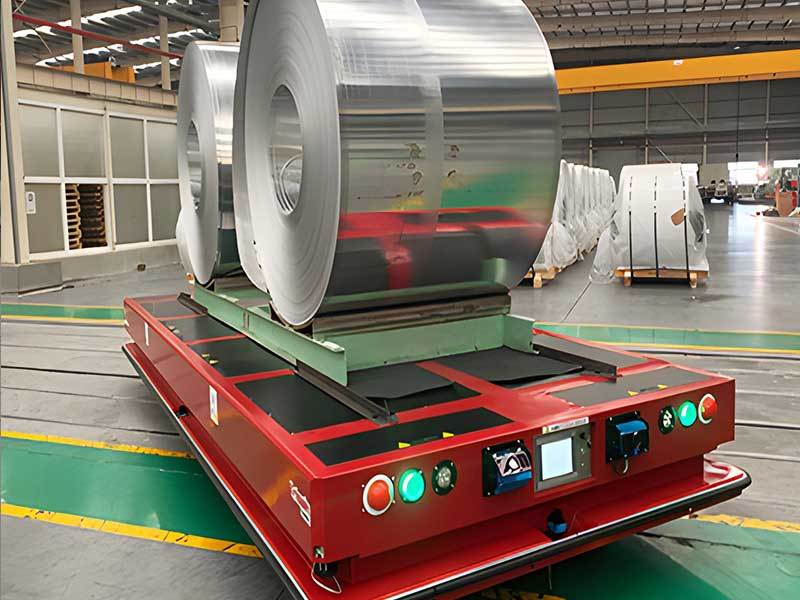
1. Lower Equipment Hardware and Procurement Costs (The Most Core Advantage)
The difference in heavy-duty AGV costs is far greater than that of light-duty AGVs: Laser solutions require multi-line laser radar, high-end industrial control hosts, SLAM algorithms, high-precision inertial navigation, and complex obstacle avoidance and path planning systems, resulting in extremely high costs for the entire navigation module. Magnetic stripe navigation only requires a bottom magnetic sensor, a simple PLC, and basic electronic control, without expensive radar and high-end algorithm chips, significantly reducing the overall hardware cost of the vehicle.
2. Extremely Strong Environmental Interference Resistance (Essential for Heavy-Duty Workshops) Heavy-duty workshops typically experience high levels of dust, oil, numerous metal work-pieces on the ground, unstable lighting, welding fumes, and dim nighttime conditions.
Magnetic Strip Navigation: Relies on the ground's magnetic field for positioning, completely unaffected by light, dust, smoke, metal obstructions, or ambient light. Even when heavily loaded and obstructed by the surrounding environment, it maintains its position, exhibiting extremely stable operation with minimal derailment or positioning drift.
Laser Navigation: Relies on laser scanning of the environment/reflector. Dust, oil, and smoke attenuate the laser signal; work-piece obstruction and strong/dim light can cause positioning drift, image loss, and misjudgment of obstacles, leading to a higher failure rate in heavy-duty scenarios.
3. Enhanced Stability and Track Accuracy Under Heavy Duty: The magnetic strip provides a physically fixed path. Even under heavy loads (10 t/20 t/50 t), starting, stopping, turning, and bumpy conditions, the track remains unchanged, maintaining stable docking accuracy (±8~10mm), fully meeting the fixed-point transport needs of steel mills, heavy industry facilities, foundries, and workshops. Laser-guided AGVs are flexible when unloaded, but their inertia is significant when fully loaded, making them prone to slight deviations in SLAM dynamic paths. These deviations accumulate to larger amounts over long distances under heavy load.
4. Simple electrical control, low failure rate, and easy maintenance: Magnetic strip AGVs have extremely simple circuitry and algorithms, requiring no complex radar or software mapping, resulting in very few potential electrical control failure points. Maintenance only requires replacing sensors and wiring, leading to low after-sales costs for manufacturers, quick on-site repairs, and minimal downtime.
Laser-guided AGVs, on the other hand, have complex radar, algorithms, and scheduling systems. Troubleshooting software bugs, radar malfunctions, and map drift is difficult, and downtime losses are higher for heavy-load equipment.
5. Quick initial deployment and simple debugging: In scenarios with fixed routes, only magnetic strips need to be attached and simple calibration is required for deployment. No on-site laser mapping, reflector installation, or complex software debugging is needed, resulting in shorter project delivery cycles.
6. Simpler and More Stable Multi-Vehicle Cluster Scheduling
Magnetic strip AGVs with fixed paths have simple multi-vehicle avoidance and queuing logic, resulting in a cost-effective and stable scheduling system. Laser AGVs, on the other hand, have complex dynamic scheduling systems with high software licensing and computing power costs, and the cost of multi-vehicle collaborative algorithms adds a significant extra expense.
Inherent Shortcomings of Magnetic Strip AGVs (Preliminary Explanation for Ease of Selection):
The path is completely fixed, requiring re-laying/cutting of magnetic strips for later route changes; the magnetic strips wear down due to long-term ground pressure, requiring regular replacement; their flexibility is far inferior to laser trackless AGVs.
II. Detailed Cost Reduction under the Same Working Environment (Heavy-Duty Specific Data, 2026 Industry Trends)
Prerequisites: Equal load capacity (10t heavy-duty class), equal drive (steering wheel/differential heavy-duty chassis), equal battery/range, equal docking functions, fixed routes from the same factory, same brand, only the navigation method differs.
(1) Cost Reduction per Unit Heavy-duty Laser SLAM AGV (Reflectorless Natural Navigation): 650,000~900,000 RMB/unit Heavy-duty Magnetic Strip Navigation AGV: 420,000~600,000 RMB/unit Direct Price Difference per Unit: 230,000~300,000 RMB Cost Reduction Ratio: 32%~40% (Industry average for heavy-duty range: 35%) Price Difference per Navigation Module (Most Core Difference) Heavy-duty Laser Complete Navigation System (Radar + Algorithm + Industrial Control + Inertial Navigation): 180,000~240,000 RMB/set Heavy-duty Magnetic Strip Complete Navigation System (Magnetic Sensor + Basic Electronic Control): 20,000~40,000 RMB/set Direct savings of 160,000~200,000 RMB on navigation modules alone. (2) Overall Project Cost (Including Ground Construction, System, Operation and Maintenance, Full Cycle)
① Initial Construction Costs
Magnetic Strip AGV: Magnetic strips are applied to the ground, approximately 20 RMB/meter, a 100-meter route costs only 2000 RMB; the ground only requires simple leveling, no other construction.
Laser AGV (Reflector Type): Installation of reflectors throughout the site, wall point marking, on-site laser mapping, and software modeling and debugging costs 15,000~30,000 RMB; Natural SLAM does not have reflectors, but mapping and debugging costs are still relatively high.
Initial construction with magnetic strips is more economical: 13,000~28,000 RMB
② Annual Operation and Maintenance Costs (3-Year Comparison)
Magnetic Strip AGV: Only periodic inspection and replacement of worn magnetic strips are required, with an average annual maintenance cost of 8,000~12,000 RMB (magnetic strip consumables are inexpensive). Laser AGV: Radar calibration, map updates, software maintenance, algorithm upgrades, and fault diagnosis are required, with an average annual maintenance cost of 25,000-35,000 RMB (high-end hardware + software after-sales costs are high).
Annual maintenance savings: 17,000-23,000 RMB, accumulating to an additional 51,000-69,000 RMB over 3 years.
③ Hidden Costs (Key to Heavy-Duty Projects)
Downtime Losses: Magnetic strips have a low failure rate and are easy to repair; laser AGVs are prone to positioning anomalies and software failures under heavy loads, resulting in higher losses per downtime.
System Software Costs: Laser AGVs come with advanced scheduling and path planning software, but the annual software license fee is additional; the basic scheduling system for magnetic strips is free/low-cost licensed.
Expansion and Route Modification Costs: No route modification is needed under fixed operating conditions, so this cost is not incurred; if no future route modifications are needed, magnetic strips incur no additional route modification costs; laser route modifications only require software map updates with zero cost (but this advantage is not applicable if your scenario is fixed).
III. Selection Conclusion (Based on your working conditions)
You described a similar working environment with fixed routes (heavy industry/steel mill/workshop fixed-point heavy-load transfer): Magnetic strip AGVs are fully compatible with no obvious shortcomings.
Cost Conclusion (can be directly used for quotations/solutions)
Single unit 10-ton heavy load: Direct savings of approximately 35% on the total vehicle purchase cost (around 250,000 RMB);
Overall cost savings over 5 years: 35%~42%.
The only situation where magnetic strip AGVs are not chosen: Laser AGVs will be prioritized only if there are frequent changes to production lines or transport routes in the future.
What types of industrial electric transfer carts are suitable for the fiberglass manufacturing industry?
Compatible Electric Transfer Carts for the Fiberglass Industry (by Priority + Model + Scenario + Advantages)
(I) Rail-Mounted Electric Carts (Preferred for fixed main line transport, most commonly used)
Suitable for fixed assembly lines in drawing, drying, winding, and weaving workshops, long-distance, high-frequency continuous transport. Stable operation, heavy load capacity, and dust resistance make it the mainstay of fiberglass main line logistics.
1. KPX Battery Rail-Mounted Electric Cart
Power Supply: Lithium battery/lead-acid battery, no external wiring. Suitable Scenarios: Raw material and fiberglass billet transport in melting workshops; hot material crossing in drying sections; fixed loop lines within workshops without fixed power supply points; emergency operation during power outages.
Suitable for short to medium distance, non-24-hour uninterrupted transport, and workstations requiring slight track turns.
Fiberglass-Specific Advantages:
* Fully sealed electrical protection for the entire vehicle; motor dust cover; bearing anti-spun fiber design; platform can be made into an anti-slip flatbed/customized yarn roll-specific limiting fixture to secure fiberglass rolls.
* Load capacity covers 5t~50t, fully meeting the needs of handling whole pallets of fiberglass, large rolls of raw yarn, and large blanks; DC motor with high starting torque, ensuring smooth start under heavy load.
* Essential Customization Features: Fully enclosed electrical box, high-temperature resistant insulated wiring, anti-fiber entanglement sealed wheels, anti-slip platform limiting, remote control operation.

2. KPD Low-Voltage Rail-Powered Electric Flatbed Cart
* Power Supply: 36V safe low-voltage power supply to the rails, no cables, no batteries, 24-hour continuous uninterrupted operation.
* Suitable Scenarios:* High-frequency, high-intensity production line for core fiberglass production lines: fixed long-distance dedicated line for drawing machine → drying oven → winding process; heavy-duty transfer on fixed main roads across workshops.
* High-temperature drying section, main line workstation for year-round continuous production, where downtime for charging is not permitted.
Fiberglass-Specific Advantages:
**No exposed cables, completely avoiding fiberglass filament entanglement and dragging, and high-temperature damage to cables; perfectly suited for dusty and high-temperature environments.**
**Reinforced and insulated vehicle body; high-temperature resistant motor design; suitable for high-temperature radiation in drying workshops; extremely stable track operation, significantly reducing yarn loosening and fiberglass product breakage.**
**Load capacity up to 200t, supporting the transfer of ultra-heavy and large fiberglass sheets and composite blanks; easily integrated with production line automation.**
**Disadvantages:** Requires insulated tracks; suitable for new workshops/production line renovations with fixed routes.
3. KPJ Cable Reel Powered Rail-Mounted Flatbed Cart
**Power Supply:** 380V AC mains + automatic cable reel unwinding. Suitable for: short distances (≤200m), single straight fixed workstations, short-distance fixed-point transfer from raw material warehouse to feeding port; renovation of old workshops; no track power supply system required.** Fiberglass Compatibility Disadvantages: Exposed cables are prone to fiberglass filament entanglement; only suitable for low-dust auxiliary areas; not recommended for main lines; requires regular cleaning of cable filament entanglement. (II) Trackless Electric Flatbed Cart (Preferred for Flexible Transfer Across Workshops and Multiple Stations) No tracks required; freely travels on concrete surfaces, turns on the spot, and navigates narrow passages. Suitable for inter-workshop, workshop-to-warehouse, and multi-point handling of scattered materials; a mainstay of secondary logistics in the fiberglass industry.
BWP Battery-Powered Trackless Electric Flatbed Cart (Industry-wide Mainstay)
Power Supply: Lithium-ion batteries; four-wheel solid rubber-coated tires; differential steering/omnidirectional movement; 360° turning on the spot. Suitable for: Cross-workshop finished product outbound; scattered transfer between finished product warehouses and raw material warehouses; irregular routes with multiple workstations; unplanned tracks in the factory; temporary transfer needs; navigating narrow passages and workshop corners.
Flexible allocation of finished fiberglass pallets, bagged fiberglass products, and small batches of yarn rolls.
Key Points for Fiberglass-Specific Customization (Mandatory Modification)
Fully enclosed dustproof structure: Motor, reducer, and wiring are all sealed in a shell to prevent fiberglass dust from entering and fiber from entangled in bearings and shafts.
High-temperature resistant solid rubber-coated wheels: Resistant to high temperatures and wear, preventing fiber filaments from embedding and causing jamming.
Customized tabletop: Anti-slip patterned tabletop + detachable yarn roll limit blocks to prevent roll material from sliding and scattering.
Remote control + manual operation, reducing direct contact between personnel and fiberglass materials.
Load capacity: 0.5t~50t full coverage, meeting the needs of all types of fiberglass materials.

(II) Intelligent AGV Automatic Transfer Flatbed Cart (The first choice for intelligent production lines and unmanned upgrades) Adapted to modern intelligent fiberglass factories, unmanned operation, 24/7 continuous operation, and integration with production line automation, solving the problems of skin itching and low efficiency caused by manual handling of fiberglass.
1. **Hollow/Backpack AGV:** Suitable for automated material handling between yarn carts, raw yarn bobbins, and small rolls in fiber drawing workshops; suitable for dense production lines, narrow passageways (2.2m narrow passages), and mixed human-vehicle traffic scenarios. Features laser SLAM navigation, high-precision fixed-point stopping, and direct docking with yarn racks for automatic loading and unloading.
2. **Forklift AGV/Pallet AGV:** Suitable for finished product warehouses, packaging workshops, automated storage and transfer of pallets of finished fiberglass products and sheet materials, and palletizing docking. Enables unmanned inbound and outbound operations with no human contact. Fiberglass-specific design. Features include high-level IP dustproof protection for the entire vehicle, fully enclosed drive wheels to prevent fiberglass filament entanglement, a smooth coating to prevent fiber adhesion, and support for multi-vehicle cluster scheduling and production line MES system integration.
(III Specialized Customized Flatbed Carts (Specific for Fiberglass Special Processes)
1. High-Temperature Resistant Electric Flatbed Cart (Customizable for both tracked and trackless models)
Suitable for: glass melting workshops, drying furnace loading and unloading, and hot fiberglass billet transfer; features include a heat-insulating coating on the frame, independent motor cooling, high-temperature resistant wiring harness, and a heat-insulating tabletop, capable of withstanding long-term ambient temperatures up to 200℃, preventing material heat radiation damage to equipment.
2. Customized Tabletop Flatbed Cart
Customized for fiberglass-specific materials:
* **Roll-Specific:** U-shaped roller tabletop, arc-shaped limiting fixtures, suitable for large-diameter fiberglass bobbins, preventing rolling and fraying.
* **Sheet/Felt-Specific:** Large-area anti-slip flatbed, side guards, for transferring large fiberglass sheets and composite sheets.
* **Lifting Flatbed Cart:** Equipped with hydraulic lifting, suitable for production lines with varying heights, seamless loading and unloading at different workstations.
What is the structure of an industrial electric trackless transfer flatcar?
An industrial electric trackless transfer flatcar mainly consists of six core parts: the car body structure, drive system, steering system, power supply system, control system, and safety system.

I. Car Body Structure (Load-Bearing Frame)
Chassis: The core load-bearing component, constructed from Q355/Q235 high-strength steel plates, I-beams, and channel steel welded into a box-type or truss structure.
Internal reinforcement ribs and partitions ensure rigidity under heavy loads and minimize deformation.
Loading Platform: Flat, non-slip steel plate platform, which can be equipped with guardrails, V-shaped frames, clamping devices, lifting rings, etc., to secure workpieces.
Customization: Lifting, tilting, and telescopic platform options are available.
Others: Includes traction hooks, maintenance pedals, mudguards, and other accessories.
II. Drive System (Power Heart)
Drive Unit
Motor: AC/DC motor; explosion-proof motors are selected for explosion-proof areas.
Reducer: Hardened gear reducer, integrated with motor and brake in a **three-in-one** drive assembly.
Brake: Electromagnetic/hydraulic brake, automatic brake engagement upon power failure, with manual release device (for emergency towing).
Wheelset:
Drive wheels: Solid polyurethane (PU)/rubber wheels, wear-resistant and protects the ground.
Driven wheels: Load-bearing auxiliary wheels, used for steering.
Axles, bearings, wheel boxes: Sealed structure, suitable for dusty environments.
III. Steering System (Flexible Core)
Differential Steering (Small Flatbed Cart): Steering is achieved by different rotational speeds of the left and right drive wheels; simple structure and low cost.
Hydraulic Steering (Medium/Large/Heavy Load): Hydraulic pump station + steering cylinder + linkage mechanism drives the front/rear wheels to deflect; high steering force and smooth operation.
Omnidirectional Steering (High-End): Equipped with Mecanum wheels/omnidirectional wheels; 360° on-the-spot rotation, lateral movement, and diagonal movement; zero turning radius.
IV. Power Supply System (Energy Source)
Battery Pack (Mainstream)
Lead-acid Battery: Low cost, mature technology, simple maintenance.
Lithium Battery: Small size, light weight, long lifespan, fast charging, maintenance-free.
Includes Smart Charger: Automatic stop when fully charged, overcharge/over-discharge/short circuit protection.
Others (Less Common)
Cable Reel: Cable-driven power supply, unlimited range but limited range of motion.
V. Control System (Operating Brain)
Core Controller
PLC (Programmable Logic Controller): The logic center of the entire vehicle.
Inverter: Controls motor speed, stepless speed regulation from 0-30m/min, smooth start and stop.
Operation Methods
Handheld Remote Control (Most Common): Wireless/wired handle, long-distance operation.
Cabin Control: With steering wheel, pedals, and instruments.
Fully Automatic AGV: Magnetic strip/laser/QR code navigation, unmanned transportation.
Electrical Components
Contactors, relays, sensors, junction boxes, power meters, emergency stop buttons.
VI. Safety System (Protection and Protection)
Active Safety: Audible and visual warning lights, horn, warning tape.
Infrared/ultrasonic obstacle avoidance sensors: Automatic deceleration/stop upon obstacle detection.
Emergency stop buttons (multiple locations).
Passive Safety:
Dampers (rubber/spring): Absorb impacts.
Fall-safe wheels, limit blocks, overload protection.
Common Faults and Emergency Procedures for Industrial Electric Transfer Carts?
Below, we have compiled a comprehensive guide covering the most common faults encountered with industrial electric transfer carts (applicable to both rail-guided flat carts and rail-less AGV flat carts), along with on-site emergency troubleshooting methods. This practical, ready-to-use resource is ideal for maintenance personnel, equipment operators, and technical support teams involved in international trade. I. Vehicle Completely Unresponsive / No Movement

**Fault Phenomenon:** After powering on, pressing the control handle or button yields absolutely no movement from the flatcar.
**Possible Causes:**
* Main power supply not connected; Emergency Stop button engaged.
* Battery charge depleted; Contactor failing to engage.
* Control circuit connections loose; Fuse blown.
**Emergency Action:**
* Reset the red Emergency Stop button (rotate clockwise to release).
* Check the power indicator light and battery voltage; if voltage is too low, charge immediately.
* Inspect the fuses and circuit breakers inside the distribution box; reset if any have tripped.
* Check if the control handle plug or control line connectors are loose; reconnect them securely.
* If still unresponsive → Temporarily bypass the circuit to test the contactor (for professional personnel only).
II. Moves but Lacks Power / Slow on Inclines / Severe Overheating
**Fault Phenomenon:** Operates normally under no-load conditions, but fails to move / moves slowly / motor becomes extremely hot under heavy loads.
**Possible Causes:**
* Insufficient battery voltage.
* Motor phase loss; Sticking bearings.
* Brake not fully released.
* Overload (excessive weight).
**Emergency Action:**
* Immediately reduce the load to prevent further damage to the motor.
* Check if the brake is locked; manually release the brake.
* Recharge the battery or swap in a spare battery.
* Listen for abnormal noises from the motor; if present, shut down the vehicle to inspect the bearings and gearbox.
III. Drifting / Erratic Speed / Vibration
**Fault Phenomenon:** Drifting off a straight path; unstable speed; vehicle body shaking.
**Possible Causes:**
* Inconsistent rotational speeds between the wheels on both sides.
* Uneven wear on wheel surfaces; debris on the tracks/ground.
* Frequency converter (VFD) parameters have drifted.
* Drive wheels are slipping.
**Emergency Action:**
* Clear any debris or oil stains from the tracks or ground surface.
* Inspect tires/wheels for wear; replace if wear is severe.
* Restart the controller to restore factory default speed parameters.
* Adjust the drive tension on both sides to ensure synchronization.
IV. Motor Abnormal Noise / Overheating / Burning Odor
**Fault Phenomenon:** Humming or clicking sounds; motor casing feels hot to the touch.
**Possible Causes:**
* Bearings lacking lubrication (dry). Damage
Gearbox oil shortage; gear stripping
Prolonged overloading
Partial short circuit in motor windings
Emergency Response
Immediately shut down the equipment; do not continue operation
Check gearbox oil level and replenish promptly
Apply high-temperature grease to bearing areas
Distinct burning odor detected → Replace the motor immediately to prevent fire hazards
V. Brake Failure: Vehicle Drifting / Unable to Stop
Symptoms: Continues to coast after power cutoff; unstable parking
Possible Causes:
Worn brake pads
Brake electromagnet malfunction
Fatigued brake springs
Emergency Response
Immediately place wheel chocks / wheel stops under the wheels to prevent drifting
Manually engage and lock the mechanical brake
Temporarily tighten the brake clearance to restore basic braking capability
Replace brake pads if wear is severe
VI. Charging Abnormalities: Failure to Charge / Rapid Power Drain
Symptoms: Charging indicator light does not illuminate; charges for a long time but yields short travel distance
Possible Causes:
Damaged charger
Battery aging / Damaged individual cell(s)
Poor contact at the charging plug
Emergency Response
Replace the charger to test
Check battery terminals for oxidation; clean (sand) and tighten connections
Abnormal voltage in a single cell → Discontinue use of that battery pack to prevent deep discharge damage to the entire set
VII. Remote Control / Controller Malfunction / Intermittent Operation
**Symptoms:** No response when pressing controller buttons; occasional loss of control.
**Possible Causes:**
* Remote control battery is depleted.
* Loose antenna connection; signal interference.
* Poor electrical contact in wiring.
**Emergency Measures:**
* Replace the remote control batteries.
* Reduce the operating distance; avoid areas with strong electrical interference.
* Switch to the wired pendant controller for emergency operation.
* Disconnect and reconnect the receiver plug.
VIII. Sudden Power Loss / Automatic Shutdown
**Symptoms:** Sudden power failure during operation; safety trip/breaker activation.
**Possible Causes:**
* Overload protection activated.
* Electrical short circuit in wiring.
* Limit switch triggered inadvertently.
**Emergency Measures:**
* Reduce the load; reset the circuit breaker.
* Check if a limit switch has been struck; manually reset the limit switch.
* Inspect cables for damaged insulation or short circuits; ensure proper insulation is restored.
IX. Simple Emergency Troubleshooting Rhymes (Easy to Remember & Practical)
**If it won't move:** First check the Emergency Stop, Power Supply, and Fuses.
**If it lacks power:** First check the Battery, Brakes, and Overload protection.
**If there are strange noises:** First stop the machine and check the Bearings and Gearbox.
**If it drifts off track:** First clear the Rails and adjust the Wheels.
**If it rolls/slips:** First wedge the wheels with Chocks and adjust the Brakes.
**If control is lost:** First switch to Wired Control or cut the Main Power.
Approximately how much cost can be saved in the steel pipe manufacturing industry by utilizing two 5-ton industrial trackless electric transfer carts equipped with lifting mechanisms?
Two 5-Ton Industrial Trackless Electric Transfer Carts with Lifting Capabilities: Cost Savings Analysis for the Steel Pipe Manufacturing Industry
For steel pipe manufacturing and storage yard environments, two 5-ton trackless electric transfer carts—equipped with lifting functions—can fully automate the entire workflow, from material cutting and transfer to final stacking. Comprehensive estimates indicate an annual net cost savings of approximately 450,000 to 750,000 RMB. These core savings stem from four key dimensions: labor replacement, efficiency improvements, reduced energy consumption, and minimized cargo damage. A detailed breakdown follows below:

I. Detailed Breakdown of Core Cost Savings (Annual Basis)
1. Labor Cost Savings (The Primary Contributor, Accounting for Over 70% of Savings)
In the steel pipe manufacturing sector, traditional methods for handling steel pipes rely on a collaborative approach involving manual labor combined with forklifts or cranes:
Traditional Configuration: A single transfer run for steel pipes requires 2 forklift operators plus 4 to 6 auxiliary handlers (including those responsible for hooking, signaling, and stacking)—totaling a team of 6 to 8 individuals per shift. To cover a 24-hour operation using a two-shift system, two such teams are required, resulting in a total workforce of 12 to 16 people.
Electric Transfer Cart Solution: Utilizing two 5-ton transfer carts with lifting capabilities—each requiring only one dedicated operator—the two-shift operation requires a total workforce of just 4 people, thereby directly replacing 8 to 12 manual laborers. Cost Estimation (Based on Industry Average Wages):
Porter Monthly Wage: ¥8,000 per person (inclusive of social security contributions); Forklift Operator Monthly Wage: ¥12,000 per person (inclusive of social security contributions).
Annual Labor Costs (Traditional Methods):
Option A (6 personnel per shift; two-shift system): (4 Porters × ¥8,000 + 2 Operators × ¥12,000) × 12 = ¥672,000 per year.
Option B (8 personnel per shift; two-shift system): (6 Porters × ¥8,000 + 2 Operators × ¥12,000) × 12 = ¥864,000 per year.
Annual Labor Costs (Electric Transfer Cart): (4 Operators × ¥8,000) × 12 = ¥384,000 per year.
Annual Labor Cost Savings: ¥288,000 – ¥480,000.
Core Value of the Lifting Function: Eliminates the need for additional manual assistance to hook or lift steel pipes, enabling a seamless, integrated "lifting–transfer–stacking" workflow. This further reduces reliance on manual labor, saving the equivalent of 2 to 3 auxiliary workers per shift compared to standard flatbed carts. 2. Efficiency Improvements and Capacity Expansion (Significant Hidden Returns)
The transfer efficiency of a 5-ton trackless transfer cart equipped with a lifting mechanism is 3 to 4 times that of the traditional method (manual labor + forklifts):
Traditional Method: A single round-trip transfer of steel pipes (including hooking, travel, and stacking) takes approximately 15–20 minutes.
Electric Transfer Cart Method: A single round-trip takes only 4–6 minutes, boosting daily transfer volume by over 200%.
Cost Savings:
Reduced Production Line Downtime (Waiting for Materials): Based on a steel pipe plant's daily output value of 100,000 RMB and a 5% downtime rate, the annual reduction in losses amounts to: 100,000 × 365 × 5% = 1.825 million RMB/year (assuming a 10% realization rate, this translates to annual savings of 182,500 RMB).
Improved Yard Turnover Efficiency: Reduces steel pipe backlog and warehousing costs, resulting in annual savings on storage and capital tie-up costs of approximately 50,000–80,000 RMB.
Total Annual Efficiency-Related Savings: 230,000–260,000 RMB.
3. Energy Consumption and Maintenance Cost Savings (Stable Long-Term Dividends)
(1) Energy Consumption Comparison (Based on 2 units operating for 250 working days/year)
Table:
| Equipment Type | Daily Energy Cost per Unit | Total Annual Energy Cost (2 Units) | Annual Savings |
| 5-ton Diesel Forklift (Traditional Method) | 200 RMB/unit/day (Fuel Cost) | 200 × 2 × 250 = 100,000 RMB | - |
| 5-ton Electric Transfer Cart | 30 RMB/unit/day (Electricity Cost) | 30 × 2 × 250 = 15,000 RMB | 85,000 RMB/year |
(2) Maintenance Cost Comparison
Diesel Forklift: Annual maintenance cost is approximately 15,000 RMB per unit; total annual maintenance cost for 2 units is 30,000 RMB.
Electric Transfer Cart: Lacks complex components such as engines or transmissions; annual maintenance cost is only 5,000 RMB per unit; total annual maintenance cost for 2 units is 10,000 RMB.
Annual Maintenance Cost Savings: 20,000 RMB/year.
Total Annual Savings (Energy + Maintenance): 105,000 RMB.
4. Product Damage & Safety Cost Savings (Direct + Indirect Benefits)
In the steel pipe manufacturing industry, manual handling and forklift operations frequently result in surface scratches, deformation, and impact damage to steel pipes. Electric transfer carts equipped with lifting mechanisms enable smooth, shock-free lifting and transport:
Product Damage Rate: Traditional methods typically result in a damage rate of approximately 2%–3%; with electric transfer carts, this rate drops to below 0.2%—a reduction of over 90%.
Based on an annual production value of 50 million RMB for a steel pipe plant, the annual savings from reduced product damage amount to: 50 million × (2% - 0.2%) = 900,000 RMB/year (assuming a 30% realization rate, this translates to annual savings of 270,000 RMB).
Safety Costs: By reducing the risks of work-related injuries associated with manual handling, as well as safety accidents involving cranes and forklifts, annual savings on safety training, injury compensation, and insurance premiums amount to approximately 50,000–80,000 RMB.
Total Annual Savings (Product Damage + Safety): 320,000–350,000 RMB.
II. Summary of Comprehensive Cost Savings (After Deducting Equipment Depreciation)
1. Net Savings After Deducting Equipment Depreciation
Equipment Purchase Cost: For two 5-ton trackless electric transfer carts with lifting capabilities, the unit price is approximately 80,000–120,000 RMB, totaling 160,000–240,000 RMB for both units.
Depreciation Period: Based on a 5-year depreciation schedule, the annual depreciation expense is 32,000–48,000 RMB.
Annual Net Savings Amount: Approximately 900,000–1,150,000 RMB (based on conservative estimates). (Based on a 50% utilization rate, the actual annual net savings range from 450,000 to 750,000 RMB.)
III. Additional Value of the Lifting Function (Cost Savings Compared to Standard Flat Cars)
Compared to standard trackless flat cars, transfer vehicles equipped with lifting mechanisms can directly replace hydraulic forklifts, manual jacks, and auxiliary hoisting procedures, generating the following additional savings:
**Hydraulic Forklift Procurement/Leasing Costs:** The purchase price for a single 5-ton hydraulic forklift is approximately 150,000 RMB. Replacing two such units saves 300,000 RMB in procurement costs, plus an annual savings of approximately 60,000 RMB in leasing costs.
**Auxiliary Manual Lifting Costs:** Eliminates the need for manual lifting of steel pipes using pry bars or jacks. This saves the labor of 2 to 3 workers per trip, resulting in additional annual labor cost savings of approximately 100,000 to 150,000 RMB.
**Improved Stacking Efficiency:** Steel pipes can be lifted directly to the required height for stacking without the need for additional hoisting equipment. This boosts stacking efficiency by 200% and reduces labor costs within the storage yard.
IV. Return on Investment (ROI) Calculation
**Total Investment for 2 Units:** 160,000 – 240,000 RMB
**Based on a conservative annual net savings estimate of 450,000 RMB,** the payback period is a mere 0.4 to 0.5 years (5 to 6 months).
**Based on maximum utilization (100% replacement of manual labor),** the payback period is just 2 to 3 months.
V. Industry-Specific Optimization Recommendations for Steel Pipe Manufacturing
**Customized Adaptation:** For large-diameter steel pipes, the vehicle can be customized with a U-shaped, anti-slip platform combined with a synchronized hydraulic lifting system to prevent pipes from rolling, thereby further minimizing cargo damage.
**AGV Upgrade:** If the production line layout is fixed, the transfer vehicle can be upgraded to a laser-guided AGV (Automated Guided Vehicle) system to enable fully unmanned operations. This eliminates the need for 4 operators, generating additional annual labor cost savings of 384,000 RMB.
**Integrated Solutions:** By integrating the transfer vehicle with specialized steel pipe lifting gear and automated stacking systems, the entire workflow can be fully automated, boosting overall cost savings by an additional 30% or more.
What Obstacle Avoidance Devices Are Found on Industrial Electric Transfer Carts?
Obstacle avoidance devices for industrial electric transfer carts (both rail-guided and rail-less) are primarily categorized into four main types: non-contact sensor-based avoidance, contact-based physical anti-collision, safety auxiliary alarms, and intelligent control systems. Together, they establish a multi-tiered protection framework encompassing "long-range early warning → mid-range deceleration → short-range emergency stop → collision protection."
I. Non-Contact Obstacle Avoidance Sensors (Active Detection; Mainstream Configuration)
1. LiDAR / Laser Scanners (Standard on High-End Intelligent Transfer Carts)
Principle: Performs 360° laser scanning to construct 2D or 3D environmental maps, enabling precise distance measurement and positioning.
Parameters: Detection range of 0.1–10m; accuracy of ±5mm.
Functions: Tiered obstacle avoidance (deceleration at 2m, emergency stop at 1m); supports SLAM navigation and dynamic path replanning (detouring).
Applications: Rail-less AGVs, intelligent RGVs, automated workshops.
2. Ultrasonic Sensors (Economical & Versatile)
Principle: Emits ultrasonic waves and measures distance based on the return echo; resistant to interference from dust, water mist, and low-light conditions.
Parameters: Detection range of 0.03–3m; error margin of <1cm.
Functions: Short-range anti-collision protection; serves to cover "blind spots" (low-lying areas) that LiDAR sensors may miss.
Applications: Front, rear, and side anti-collision protection for both rail-less and rail-guided transfer carts.
3. Infrared / Photoelectric Sensors (Basic Anti-Collision)
Principle: Utilizes infrared emission and reception to detect the presence or absence of obstacles.
Parameters: Detection range of 0.1–2m; characterized by fast response times and low cost.
Functions: Triggers short-range alarms, deceleration, and emergency stops.
Applications: Rail-guided transfer carts, simple material handling carts.
4. Vision-Based Obstacle Avoidance (AI Intelligent Recognition)
Principle: Combines AI-enabled cameras with advanced algorithms to identify and classify personnel, materials, and equipment types.
Functions: Distinguishes between dynamic (moving) and static obstacles; enables intelligent avoidance maneuvers and dynamic path replanning.
Applications: High-level autonomous transfer carts. II. Contact-based Physical Anti-Collision (The Last Line of Defense)
1. Safety Edges / Anti-Collision Strips (Mechanical Emergency Stop)
Principle: Pressure triggers an internal switch, immediately cutting power and applying the brakes.
Installation: Along the bottom perimeter of the vehicle body, as well as at the front and rear ends.
Features: Reliable, cost-effective, and free of blind spots.
2. Buffers (Rubber / Spring-loaded)
Function: Absorb collision impact to protect both the vehicle body and the obstacle.
Applicability: Heavy-duty rail transfer carts and large-tonnage transport vehicles.
Buffer
III. Safety Auxiliary and Alarm Devices
Audible and Visual Alarms: Flashing warning lights and a buzzer activate during operation to alert personnel to clear the path.
Emergency Stop Buttons (E-Stop): Strategically placed at multiple locations on the vehicle body; a single press cuts power and applies the brakes.
Pull-Cord Emergency Stops: Suitable for long-bodied vehicles or large workshops; allows for emergency stopping to be triggered from any point along the cord.
Limit Switches: Positioned at track endpoints or zone boundaries to automatically stop the vehicle and prevent overrunning.
IV. Intelligent Obstacle Avoidance Control System
Hierarchical Control Logic:
Long Range (5–10m): LiDAR-based early warning.
Medium Range (2–3m): Ultrasonic / Infrared detection → Deceleration.
Short Range (0.5–1m): → Emergency stop and alarm.
Contact: → Safety edges / Buffers trigger a forced shutdown.
Multi-Sensor Fusion: LiDAR + Ultrasonic + Vision + AI, ensuring comprehensive coverage with no blind spots.
SLAM Navigation: Real-time mapping, dynamic obstacle avoidance, and automatic rerouting.
V. Common Configuration Combinations (By Vehicle Type)
Basic Rail Transfer Cart: Anti-collision strips + Audible/Visual alarms + Emergency stop buttons.
Standard Trackless Transfer Cart: Ultrasonic sensors + Anti-collision strips + Audible/Visual alarms + Emergency stop buttons.
Intelligent AGV/RGV: LiDAR + Ultrasonic sensors + Vision systems + Safety edges + Hierarchical control system.
How much cost can an 80-ton electric turntable save in the heavy machinery assembly and processing industry?
An 80-ton electric turntable can typically save 30% to 60% on overall costs in heavy machinery assembly/processing, and the equipment investment can be recovered in 1 to 3 years. The following breakdown is based on dimensions (taking a heavy industry workshop, 250 working days per year, and 8 hours/day as an example):

I. Labor Cost Savings (Most Direct)
Traditional Method (Crane + Manual Labor):
80-ton work-piece alignment/rotation: 3-6 person team + 1 crane operator
Average daily wage (including social security): 400-600 yuan
Single rotation/alignment: 20-60 minutes
Multiple operations per day: Labor cost 3000-8000 yuan/day
Using an 80-ton electric turntable:
1 person remote control operation, completed in 1-3 minutes
Daily labor cost: 400-800 yuan
Savings: 70%-85% of labor
Annual labor savings: Approximately 600,000-1,500,000 yuan (based on 3-5 people, 250 working days)
II. Time and Capacity Savings (Core)
Traditional: Crane lifting, repeated alignment, multiple personnel cooperation: Single workstation time 30-90 minutes Minutes
Waiting for cranes, dispatching, and safety confirmation: Significant wasted waiting time
Electric turntable:
360° rotation, 0.1°~1° precise positioning, one-button operation
Single workstation time: 2~10 minutes
Efficiency increase: 3~10 times
Converted cost:
Single product assembly cycle: shortened by 30%~50%
Workshop daily capacity: increased by 40%~80%
Site turnover rate: increased by 2~3 times
Annual production capacity revenue: approximately 1 million~3 million RMB (calculated based on output value and interest/rent)
III. Crane/overhead crane usage cost savings
Traditional:
80-ton overhead crane shift fee: 2000~5000 RMB/day
Fuel consumption/electricity costs, maintenance, depreciation, wire rope wear
Crane occupation, queuing, and dispatching costs
After using the turntable:
Reduced crane utilization rate by 60%~90%
Crane can be freed up for other lifting operations
Annual crane cost savings: approximately 30 10,000 to 800,000 RMB
IV. Quality and Rework Cost Savings (Hidden but Huge)
Traditional Manual Alignment:
Large errors, bumps, scratches, flange misalignment
Rework rate 5%–15%
Single rework: 5,000 to 50,000 RMB in labor time + materials + delays
Electric Turntable:
High precision, smooth and shock-free, one-step alignment
Rework rate reduced to 0.5%–3%
Annual savings in rework/scrap: Approximately 200,000 to 1,000,000 RMB
V. Safety and Accident Cost Savings
Traditional:
Multiple people working at heights/under heavy loads, high risk of injury, collision, and rollover
Accident compensation, production stoppage, safety supervision penalties, increased insurance premiums
Turntable:
Single-person remote control, fully enclosed/limited/self-locking
Safety accident rate reduced by 90%+
Annual hidden safety savings: 100,000 to 500,000 RMB (including risks)
VI. Maintenance and Energy Consumption Comparison
Electric Turntable: Annual maintenance cost 10,000 to 30,000 RMB Low power consumption (variable frequency conversion)
Crane + labor + frequent lifting: higher maintenance, wire rope, fuel consumption, and downtime due to malfunctions
Annual maintenance difference: approximately 50,000 to 150,000 yuan in savings
VII. Overall Cost Savings (Typical Range)
Total Annual Cost Savings: 1.5 million to 3.5 million yuan (depending on shifts, output, and work-piece size)
Investment in an 80-ton electric turntable: approximately 400,000 to 800,000 yuan (including table, drive, and control)
Investment Recovery Period: 1 to 3 years (most companies recover their investment within 1.5 years)
VIII. Typical Industry References (80-ton class)
Wind turbine tower/nacelle assembly: 40% to 60% cost savings
Heavy machine tool/construction machinery assembly: 35% to 50% cost savings
Pressure vessel/boiler welding: 30% to 45% cost savings
Metallurgy/steel coil/heavy component transfer: 25% to 40% cost savings
IX. Quick Estimation Formula
Annual savings ≈ (labor + crane) (+Rework + Time) × Efficiency Improvement Coefficient
Labor: (Original Number of People - 1) × Daily Wage × 250 Days
Crane: Original Shift Cost × 0.7~0.9
Production Capacity: Monthly Output Value × Cycle Reduction Rate
Quality: Annual Rework Loss × 0.8~0.95

It founded in the 2000s, It has a history of about 20 years. We own a professional produce team,sales team and a after-sale service team, which can make sure satisfy your whole purchase procedure.
Contact Us
Whatsapp:8613507096268
E-mail:sales@aifitemhe.com
Weizhuang, Changyuan,Xinxiang city, Henan province, China